Catherine de' Medici (1519 - 1589)
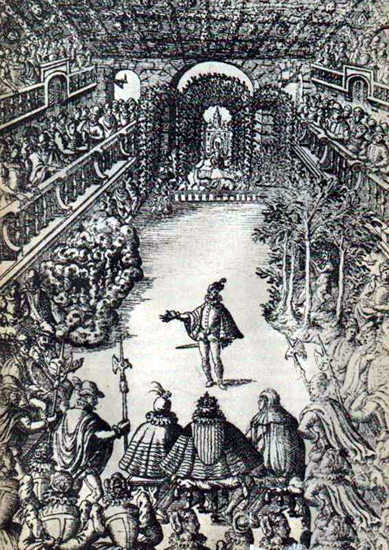
Like much of modern Western art, what we now call classical ballet began to assume its current form in the Renaissance. At that time the court presented pageants on a grand scale. Looking at some of the pictures that depict these events you could equate them with the opening ceremonies of the Olympic Games.
Bergonzio di Botta, Italian dance master, arranged the first lavish Italian ballet, in 1489 on the occasion of the marriage of Galeazzo Visconti, Duke of Milan, to Isabel Aragon in Torrona. The individual dances matched the various courses of the dinner--with Jason and the Argonauts serving as the connecting thread. So greatly were the people impressed by the ballet, described by Tristano Calco, that there were many other similar ballets, thus preparing the path which eventually led to the "Ballet Comique de la Reine."
Before there could be ballet there had to be a person and situation to foster its advancement. That person was Catherine de' Medici, and she created the situation. Catherine de' Medici was born 1519 into the richest non-royal family in Europe. She was the granddaughter of Lorenzo the Magnificent and related to two Popes, Leo X and Clement VII. She was orphaned in infancy, so Pope Leo X had her sent to Rome to live with a family connected with the papacy. When she was 6 she was brought back to Florence and all of the splendor of the Medici wealth. When she was 10 the Medici's foes forced them to flee Florence. Catherine was placed in Murate Convent, where she was educated by the nuns and became fluent in Greek and Latin.
Pope Clement VII and Francis I arranged her marriage at 14 to the 14 year old Henry, Duke of Orleans, second son of the French ruler. Henry had already spent 2 years in a Madrid cell as a hostage. On his release he was insolent and rude. The king thought that the young Henry needed to be refined and he asked Diane de Poitiers to guide this rebellious youth in the graces of the court. Even though Diane was 20 years his senior she became his mistress and rode at his side while Catherine followed behind. Catherine shouldered this position with a stoic coldness. It was Diane who encouraged Henry to father children so that the royal line of Valois could continue. Catherine mothered 10 children, seven survived. 3 girls and 4 boys. With the death of Henry's older brother and his father he found himself ruler of France at the age of 28.
After 12 years Henry died in a freak jousting accident at the celebration of his 15 year old daughter Elizabeth's marriage to Phillip II of Spain. Catherine became the Queen Mother of the next three kings of France. She never lost the love of her Italian background and the arts that her family sponsored. She made the Italian pageants part of the French court. Daily dance classes became a requirement of the courtesans.
At this time there was a great conflict between the Catholics and the Huguenots (French Protestants). Catherine tried to bring peace between the two factions but neither side wanted anything but complete victory. Catherine arranged a marriage between her reluctant daughter Margaret and Henry of Navarre, leader of the Huguenots. Hundreds of Huguenots gathered in Catholic Paris. Two days after the wedding the pageant "Le Paradis d'Amour" was presented at the palace of the Louvre. Margaret's brothers took part in this pageant.
Another two days passed when Coligny, an important leader of the Huguenots, was killed. This incident was the cause of the St. Bartholomew Day Massacre. It is estimated that over 50,000 people were murdered August 24th, 1572. Most historians claim Catherine had planned this event to get the Huguenots into a closed area and then massacred them. In your history books this is how she is remembered.
Catherine de Medici's, first son Francis II was married to Mary Queen of Scots. He died after one year on the throne. His wife, age 16, returned to Scotland and was later beheaded by Elizabeth I. Charles IX, married Anne of Austria, ruled during the massacre. He died at age 24. Henry, Duke of Anjou (later to be Henry III) was always Catherine's favorite and through her efforts served on the throne of Poland. When his brother died he returned to France and was crowned Henry III of France. Henry was described in Dance Magazine May 1990 as brilliant, erratic, homosexual and a transvestite. To please Henry, Catherine arranged "Ballet Comique de la Reine" to celebrate the marriage of Henry's favorite, Duke de Joyeuse, to Margaret of Lorraine. This extravagant entertainment (Ballet Comique de la Reine) cost more than a million ecue.
Balthasar de Beaujoyeux, an Italian violinist, came to Paris in 1555. Thanks to his gift of organizing fetes at the royal court, he made rapid gains in his career. As a personal servant to Catherine de' Medici he participated in masquerades "Defense du Paradis", "Ballet Aux Ambassadeurs Polonais", and his most important work, the "Ballet Comique de la Reine" in 1581, considered the first ballet de cour.
There are two reasons to credit this as the first ballet. It had a central theme that told a story. Sets, costumes, music and dialogue were all coordinated. Also, after its success Catherine had Beaujoyeux write down the libretto and music. She had artists draw pictures of the event and sent them to all the courts of Europe. The world was so impressed that they tried to emulate similar ballets. They also replaced their Italian ballet masters with those from France. This is how the language of ballet became French. Italy became more interested in opera and England in drama.
Catherine de' Medici died January 5, 1589 of pneumonia. It is said that she was strong enough to overcome her illness, but her disappointment with her favorite son caused her to die of a broken heart. Nostradamus told Catherine that after her death, a beautiful flower would grow from bloodstained soil. Quoting Lydia Joel's article in Dance Magazine".... the finesse and elegance of our ballet dancers on-stage today, we are looking at the beautiful flower that grew from the bloodstained soil of the War of Religion."
(First published September 1990)